
Is Cancer Skin Care Covered by HSA or FSA? A Patient's Guide to Paying Less Out of Pocket
- Why Does the Skincare Brand You Choose Actually Matter During Cancer Treatment?
- What to Look for When Choosing a Skincare Brand During Cancer Treatment
- Is There a Best Cream for Skin Cancer?
- Ingredients to Avoid During Chemotherapy, Radiation, or Post-Procedure Recovery
- How Dermavitality's Product Line Matches These Criteria
- When to Check With Your Oncology or Dermatology Team Before Trying a New Product
- Here's How Dermavitality Can Help
- Frequently Asked Questions
- References
Choosing the right skincare brand during cancer treatment means looking past marketing claims to focus on fragrance-free formulas, ingredient transparency, and products designed for specific side effects like chemo rash, radiation-sensitive skin, or hand-foot syndrome. This guide covers what oncology teams recommend looking for, plus how to match a product to your specific symptoms.
Why Does the Skincare Brand You Choose Actually Matter During Cancer Treatment?
A quick search for "best skincare for cancer patients" turns up dozens of brands, all making similar promises: gentle, soothing, dermatologist-recommended. When your skin is already reacting to chemotherapy, radiation, or a recent procedure, it's hard to tell which of those claims are backed by anything and which are just packaging.
The truth is that most standard skincare products, even ones marketed as sensitive-skin friendly, aren't formulated with cancer treatment side effects in mind. A moisturizer built for everyday dryness isn't necessarily built for the kind of peeling, cracking, or nerve-related discomfort that shows up during chemo or radiation. That's an important distinction, because the American Cancer Society and the National Cancer Institute both note that treatment-related skin changes often need gentler, more specific care than typical over-the-counter products provide.
This guide breaks down the actual criteria that matter, not brand names or marketing language, so you can evaluate any product with a clearer eye. It also looks at how to think about the search "best cream for skin cancer," since no cream treats or cures skin cancer itself, and covers where Dermavitality's product line fits into these criteria.
What to Look for When Choosing a Skincare Brand During Cancer Treatment
Rather than chasing a single "best" brand, oncology guidance points to a specific set of criteria. A product that checks these boxes is a reasonable candidate regardless of which company makes it.

Fragrance-Free and Dye-Free Formulas
The National Cancer Institute and American Cancer Society both flag added fragrance and alcohol as common irritants during treatment. Look for products labeled fragrance-free (not just "unscented," which can still contain masking fragrance) and free of added dyes.
Ingredient Transparency
A brand that lists its full ingredient panel clearly, and can explain why each ingredient is there, is easier to vet than one relying on vague terms like "proprietary blend." This matters more during treatment, when your care team may ask what's in a product before you use it near a treatment site.
Formulated for a Specific Side Effect, Not Just "Sensitive Skin"
General sensitive-skin lines are designed for conditions like eczema or rosacea. Side effects like hand-foot syndrome, radiation-sensitive skin, or chemo-related scalp irritation have their own patterns and triggers, so a product built specifically around one of those side effects tends to fit better than a general moisturizer relabeled for oncology use.
Gentle, Low-Irritant Base Formulas
That means free of alcohol, free of common irritants like retinoids or exfoliating acids, and typically pH-balanced or hypoallergenic. The American Cancer Society specifically recommends hypoallergenic, cream-based, unscented moisturizers as a safe default.
Developed With Input From Oncology Professionals
A brand that involves oncology nurses or clinicians in its formulation process, or that provides clear guidance on when to check with your care team, generally reflects a better understanding of what treatment-related skin actually needs versus a line built for the general market and marketed toward cancer patients afterward.
Is There a Best Cream for Skin Cancer?
It's worth answering this directly: no over-the-counter cream, including anything Dermavitality sells, treats, cures, or prevents skin cancer. Skin cancer is diagnosed and managed by a dermatologist or oncologist, typically through biopsy, surgical removal, topical prescription medication, radiation, or a combination of these, according to the National Cancer Institute.
What this search is often really asking is something more practical: what helps skin that's recovering from a skin cancer removal procedure, or skin that's undergoing radiation as part of skin cancer treatment. That's a different, and answerable, question. After a procedure like a Mohs surgery or excision, or during a course of radiation, skin typically needs gentle cleansing, fragrance-free moisturizing, and sun protection while it heals, following whatever specific instructions your surgeon or radiation oncologist gives you.
If you're looking for a product to support skin during or after skin cancer treatment, rather than a product marketed as treating the cancer itself, the same buying criteria above apply: fragrance-free, gentle, and ideally formulated with input from oncology professionals.
Ingredients to Avoid During Chemotherapy, Radiation, or Post-Procedure Recovery
When you're comparing labels, a few ingredient categories come up consistently in oncology guidance as ones to skip or use only with your care team's go-ahead:
- Alcohol. Found in some toners, sprays, and quick-dry lotions. Both NCI and ACS list alcohol as a common drying, irritating ingredient during treatment.
- Added fragrance and dyes. These are among the most frequent triggers for treatment-related skin reactions, even in products marketed as gentle.
- Retinoids, AHAs, and BHAs. Exfoliating acids and retinol can increase sensitivity and irritation on skin that's already compromised by treatment.
- Lanolin. Some patients have an allergic reaction to lanolin in moisturizers, which is why several cancer centers recommend checking labels closely, particularly on radiation-treated skin.
- Antibacterial or heavily fragranced soaps. ACS guidance specifically calls these out as capable of making skin "too dry" during treatment.
This isn't a complete list, and individual reactions vary. Always run a new product by your oncology nurse or care team before applying it to treatment-affected skin, especially near a radiation site or surgical area.
How Dermavitality's Product Line Matches These Criteria
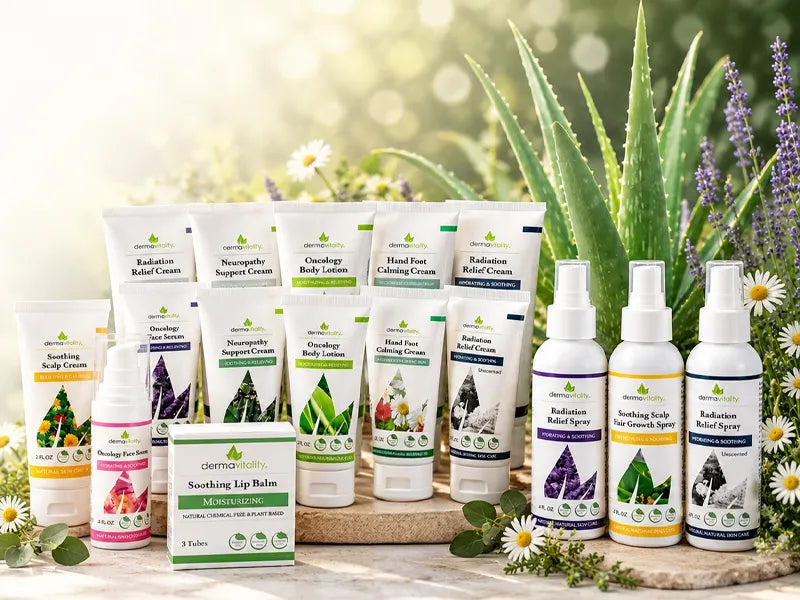
Rather than a general "best of" list, the more useful comparison is matching a product to your specific symptom. Here's how Dermavitality's line lines up against the criteria above, organized by what you're actually dealing with:
| Your Main Concern | What to Look For | Dermavitality Fit |
|---|---|---|
| Chemo-related dryness, rash, or peeling skin | Fragrance-free, hydrating body lotion made for treatment-affected skin | Best Lotion for Chemo Skin, part of the Chemo Skin Care collection |
| Radiation-sensitive or irritated skin | Calendula-based, unscented, plant-rich botanical formula | Radiation Burn Cream and Calendula Cream, in the Radiation Burn Care collection |
| Hand-foot syndrome | Non-greasy, fast-absorbing cream for hands and feet | Hand-Foot Syndrome Cream, in the Neuropathy collection |
| Nerve-related tingling or numbness | Fast-absorbing formula for ongoing daily use | Neuropathy Cream, in the Neuropathy collection |
| Chemo-related scalp dryness or hair thinning | Gentle, hydrating scalp-specific formulas | Chemo Hair and Scalp Care Bundle, in the Scalp and Hair Care collection |
| Everyday sensitive skin between flare-ups | Plant-based daily cleanser and moisturizer | The Restore collection (cleanser, body lotion, barrier cream, and face serum) |
| Not sure where to start | A low-commitment way to test fit and fragrance sensitivity | The Sample Packs collection |

Every product above is formulated specifically for treatment-related skin concerns rather than adapted from a general skincare line, which is the core criterion from the buying guide above.
When to Check With Your Oncology or Dermatology Team Before Trying a New Product
Even a product that meets every criterion above is worth clearing with your care team first, especially in a few specific situations:
- Before applying anything new to skin at or near a radiation treatment site, since some products can interfere with treatment if used too close to a session.
- Before using a new product on broken, open, or actively weeping skin.
- If you notice a new rash, blistering, or worsening pain after starting a product, stop use and contact your care team.
- If you're managing multiple side effects at once (for example, hand-foot syndrome and neuropathy together) and aren't sure which product to prioritize.
- Before combining a new topical product with any prescription cream your oncologist or dermatologist has already given you.
A quick patch test on a small area of unaffected skin, waiting 24 hours before wider use, is a reasonable first step with any new product, treatment-related or not.
Here's How Dermavitality Can Help
- Every product is formulated for a specific treatment-related concern, not adapted from a general skincare line.
- Formulas are fragrance-free or use gentle, plant-rich botanical ingredients like calendula, with full ingredient transparency.
- The Sample Packs collection lets you patch-test a formula before committing to a full-size product.
- The Oncology Support Bundles collection covers multiple side effects in one order, useful when you're managing more than one symptom.
- Products are designed to be discussed openly with your care team, and every product page links to full ingredient information.
- Read Dermavitality's treatment and product disclaimer before starting any new skincare product during treatment.
Frequently Asked Questions
Is there a cream that treats skin cancer?
No. Skin cancer is diagnosed and treated by a dermatologist or oncologist through methods like biopsy, surgical removal, prescription topical medication, or radiation. Over-the-counter creams can support skin comfort during recovery from these treatments, but none of them treat, cure, or prevent skin cancer itself.
What ingredients should I avoid in skincare during chemotherapy?
Oncology guidance commonly flags alcohol, added fragrance, dyes, retinoids, and exfoliating acids like AHAs and BHAs as ingredients that can irritate treatment-affected skin. Always check with your care team before trying a new product, especially near a treatment site.
Is fragrance-free the same as unscented?
Not necessarily. "Unscented" products can still contain masking fragrance to cover other ingredient smells. "Fragrance-free" means no fragrance ingredients were added at all, which is the safer label to look for during treatment.
How do I know if a skincare brand is actually made for cancer patients?
Look for ingredient transparency, formulas built around specific side effects (rather than general "sensitive skin" claims), and involvement from oncology professionals in product development. A brand's own site or product labeling should make this clear.
Can I use the same skincare brand for chemo and radiation side effects?
Sometimes, but not always. Chemo-related dryness and radiation-sensitive skin can respond differently, so it's worth choosing products formulated for your specific side effect rather than assuming one product covers everything. Your care team can help confirm what's appropriate for your treatment.
Should I tell my oncology team what skincare products I'm using?
Yes. It's worth mentioning any new topical product to your care team, particularly if you're receiving radiation or have open or healing skin, since some ingredients or timing considerations can affect treatment.
References
- American Cancer Society. "Rashes and Skin Changes."
- National Cancer Institute. "Skin and Nail Changes and Cancer Treatment."
- National Cancer Institute. "Skin Cancer Treatment (PDQ) – Patient Version."
Leer más

Hand-foot syndrome and treatment-related skin sensitivity can make daily tasks like washing dishes or gardening surprisingly uncomfortable during cancer treatment...

Oncology nurses most often recommend lukewarm washing with a mild, fragrance-free cleanser, patting skin dry, and using a gentle...