Best nurse-formulated radiation skincare in 2026

- What radiation skincare options can you choose from?
- What should you compare in a radiation skincare product?
- How do natural and standard clinical radiation skincare approaches compare?
- What should you ask before you choose a radiation skincare product?
- How much does radiation skincare cost?
- Which radiation skincare approach should you choose?
- Frequently asked questions
- Ask your care team before you buy
Oncology teams most often recommend plain, fragrance-free emollients. The best nurse-formulated natural skincare products for radiation therapy patients in 2026 are plant-based creams that sit alongside that routine with your team's approval. This guide compares both approaches, lists what to check on a label, and gives you questions to bring to your next appointment. It is written for patients and caregivers, and for oncology nurses and navigators who recommend products.
What radiation skincare options can you choose from?
Your options are nurse-formulated botanical products and standard clinical emollients, the plain creams cancer centers already name.

Nurse-formulated botanical skincare
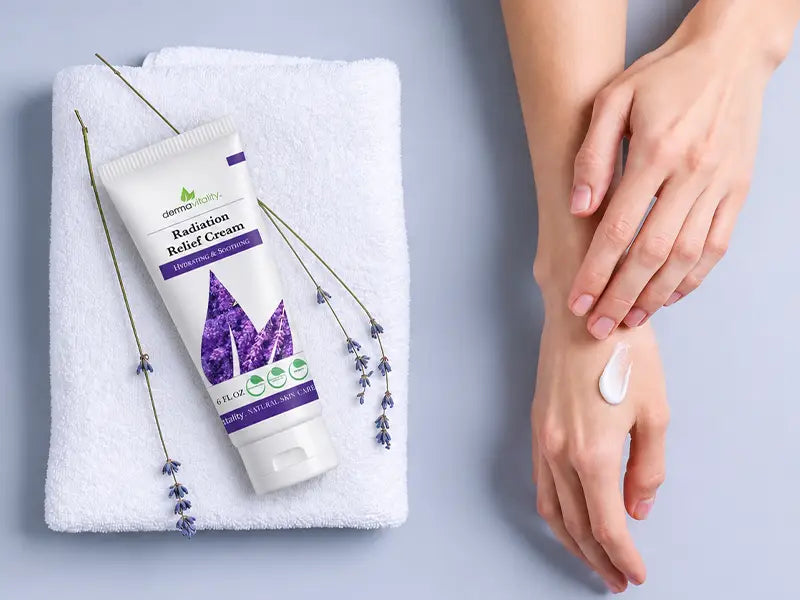
These are plant-based products developed by an oncology nurse. Dermavitality's Radiation Relief Cream combines organic calendula, aloe vera, shea butter and botanical hyaluronic acid, and it is free from parabens, phthalates, sulfates and petrochemicals. Its directions say to start 1 week before treatment, apply 3–4 times daily, and skip it within 1 hour before a session.
Standard clinical emollient skincare
These are plain, fragrance-free creams and lotions that your cancer center already recommends. The Oncology Nursing Society counts them as part of the standard regimen. That regimen is mild soap and water, gentle patting dry, and a hydrating lotion that you or your physician choose. Some patients pair a botanical cream for comfort with an emollient for barrier support, and the oncology nurse decides which goes on when.
What should you compare in a radiation skincare product?
Oncology nurses judge a radiation skincare product on three things: what is in it, what the evidence says, and whether your team has approved it.
Fragrance-free and alcohol-free formulas
- Unless a label says "fragrance free," a product likely contains fragrance, even if it says "unscented."
- The MD Anderson clinical algorithm calls for emollients free of alcohol, perfumes and other chemical irritants.
Botanical ingredients and clinical evidence
- Calendula, aloe vera, shea butter and oat oil add gentle hydration, and a short ingredient list is easy to check.
- The ONS guidelines suggest against calendula as an add-on to the standard regimen (conditional, low certainty) and recommend aloe vera only in a clinical trial. Treat botanicals as comfort care that sits next to standard care.
Timing guidance and care team approval
- Look for clear directions on when to skip the product before a session; your team's instruction overrides the label. Our guide on using cream during radiation treatment explains why timing matters.
- Bring the label to your oncology nurse, who knows your treatment plan and your skin.
How do natural and standard clinical radiation skincare approaches compare?
A systematic review in PMC reports that about 95% of patients develop some manifestation of acute radiation dermatitis. It happens within the first 90 days of radiation therapy.
Natural botanical vs. standard clinical emollients
| Criterion | Nurse-formulated botanical | Standard clinical emollient |
|---|---|---|
| Ingredient transparency | Usually short, plant-based lists; read the label for fragrance | Plain lists; read the label for fragrance and alcohol |
| Clinical evidence | ONS suggests against calendula as an add-on (conditional, low certainty) and aloe vera only in a trial | ONS counts general emollients as part of the standard regimen |
| Fragrance profile | Choose a fragrance-free version | Choose a fragrance-free version |
| Timing guidance | Varies by product; follow your team's instruction | Follow your team's instruction |
| Access | Direct purchase, or free samples through provider programs | Pharmacy, often named by your cancer center |
Source: ONS Guidelines for Cancer Treatment-Related Radiodermatitis, November 2020; American Academy of Dermatology.
Where the two approaches overlap
Both share the same ground rules: gentle washing, fragrance-free formulas, and an oncology team that signs off. Botanical products sit alongside standard care as comfort and relief, so your team's recommendations come first. The ONS panel also called for shared decision-making, with clinicians weighing each patient's values and preferences.
What should you ask before you choose a radiation skincare product?
Bring these questions to your next oncology appointment and ask your nurse or radiation oncologist to review any product before you apply it.
Questions about ingredients and safety
| Question to ask | Answer to look for | Red flag to watch for |
|---|---|---|
| Is it fragrance-free? | The label says "fragrance free" | Only "unscented," or a perfume listed |
| Does it contain alcohol? | No alcohol or perfume, as MD Anderson advises | Alcohol among the ingredients |
| Does it contain metallic compounds? | A metal-free ingredient list, or your team's okay | Metal-based ingredients your team has not cleared |
| Is the full ingredient list public? | A complete list on the label and website | A vague "proprietary blend" |
| When do I skip it before a session? | A specific time from your team | No timing guidance at all |
| Has my care team approved it? | Yes, a nurse or oncologist reviewed it | Advice to skip asking your team |
Questions about timing and usage
Ask when to start before your first session, how long before each session to skip the product, and how long to continue after your last. Teams answer these differently. One botanical cream's directions run up to 6 weeks after your final session. MD Anderson's algorithm suggests considering emollients daily for at least 6 months to 1 year.
How much does radiation skincare cost?
What you pay depends on the product, its size and where you get it, and a few routes can lower the bill.
What radiation skincare costs
- Product and size: check the current listing for the product and size you plan to buy, since both change the price.
- Ballpark: a ScienceDirect review cites a study. It put the mean skin toxicity cost, including soothing ointments and moisturizers, at $131.64 per breast cancer patient undergoing radiation (Schnur et al., 2012). It is an older figure for one patient group, so use it only as a rough guide.
- Coverage: ask your plan administrator whether the product you choose is HSA/FSA eligible before you buy.
How to access products through your care team
- Dermavitality offers free sample packs to patients and health care practitioners through a sample request form.
- Its patient assistance program supports low-income and underserved patients.
- Ask your oncology nurse or radiation therapist whether your clinic stocks samples.
- A sample lets you try a nurse-formulated, plant-based Dermavitality formula made for radiation-sensitive skin before you commit to a full-size jar.
Which radiation skincare approach should you choose?
The right pick depends on whether your skin is intact, red, or open, and on what your care team has approved.
Matching your approach to your treatment stage
- Choose a nurse-formulated botanical cream if your skin is intact, you want plant-based, paraben-free comfort care, and your team has approved the ingredient list.
- Choose a standard clinical emollient if your cancer center already names a brand and your nurse wants you to stay with it.
- Choose either one, in a fragrance-free version, for early redness (erythema) or dry, itchy skin (pruritus) once your team agrees.
- Choose neither and call your team if skin weeps or opens (moist desquamation). Open skin needs your team's wound care instructions, not a cream.
- Keep going after your final session if your team says so, since ONS notes late skin effects can appear months to years after radiation.
Frequently asked questions
Can I use cream during radiation treatment?
Yes, with your team's approval. A good routine starts with a gentle wash of treated skin in warm water. Splash it with your hands instead of using a washcloth or loofah, pat dry, then apply the approved cream. Ask your nurse for the exact window to skip it before each session.
What ingredients should I avoid in radiation skincare?
Skip antiperspirant and talcum powder, because the AAD says their ingredients can increase the radiation dose you receive. Keep anything sticky off the treated area, such as medical tape, stick-on bandages and nicotine patches, and avoid shaving it. ONS also advises against scratching, hot tubs and sun exposure.
Is a nurse-formulated botanical cream safe to use alongside radiation therapy?
Only when your care team knows what you use and approves it. Cosmetic skin care products are not drugs, and the FDA does not evaluate them as medicines, so tell your team what you use. Stop and call them if skin breaks open. Watch for darkening too: Reuters reports that darker skin does not redden as radiation dermatitis develops; it darkens.
How do I get nurse-formulated skincare through my oncology team?
The AAD advises that if your care team does not suggest products, you should ask. Nurses and navigators can request free samples for the clinic through a brand's healthcare provider page. Bring the question table above so the answers get written down.
Ask your care team before you buy
Ask your care team for a free Dermavitality sample, and bring the questions from this guide so your nurse can check the ingredient list with you. You get a trial run of a nurse-formulated cream before spending anything. Dermavitality's co-founders are Mark Brown, RN, an oncology nurse, and Lesley Nygaard, a breast cancer survivor. According to the Dermavitality homepage, 20% of Dermavitality's proceeds support the National Breast Cancer Foundation's HOPE Kit program.