Lumpectomy and Mastectomy Scar Care: Healing Tips After Breast Cancer Surgery
- What Does a Healing Mastectomy or Lumpectomy Scar Look Like Week by Week?
- How Long Does It Take for a Mastectomy Scar to Heal?
- How to Care for a New Mastectomy or Lumpectomy Scar
- What Causes Tight or Raised Scar Tissue After Surgery?
- What About Radiation Scars?
- When to Call Your Surgical or Oncology Team About a Scar
- Here's How Dermavitality Can Help
- Frequently Asked Questions
- References
A mastectomy scar or lumpectomy scar changes for months after surgery, and it's not always obvious what's normal. This guide covers how long mastectomy scars typically take to heal, practical scar care habits, what causes tight or raised scar tissue, how radiation scars are different, and when to loop in your surgical team.
What Does a Healing Mastectomy or Lumpectomy Scar Look Like Week by Week?
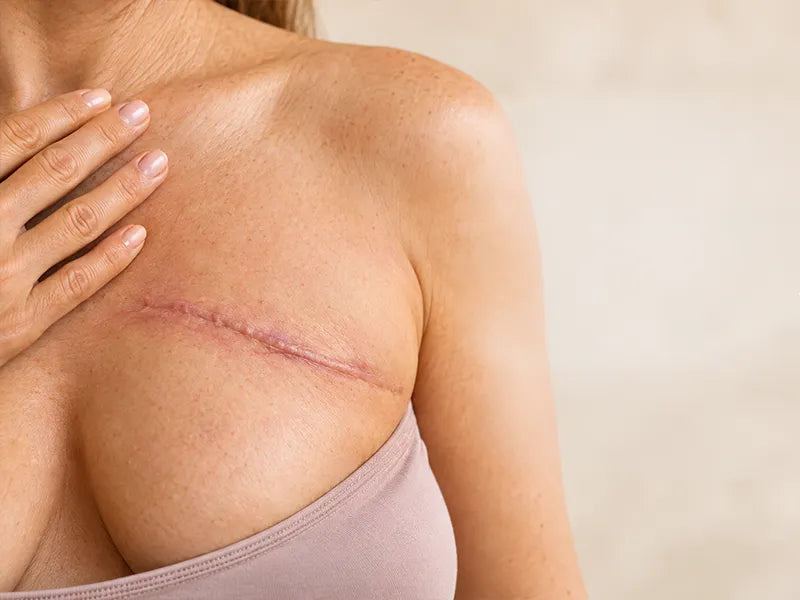
A few days after surgery, the incision line is still pink, a little raised, and tender to the touch. A few months later, it might be flatter, paler, and less noticeable, or it might feel tight, itchy, or numb in ways nobody warned you about. Both are common, and both are worth understanding rather than just waiting out.
A mastectomy scar (and a lumpectomy scar, which tends to be smaller) is your body's version of repair work: collagen fibers rebuild the layers the incision went through. Surgeons often place the incision along the armpit, around the areola, or in a skin crease specifically to make the eventual scar less visible, but scarring itself is a normal, expected part of healing. It doesn't fully disappear, though it typically fades and softens with time.
This guide walks through a realistic healing timeline, the day-to-day habits that support a scar as it settles, what tight or raised scar tissue actually is, how radiation scars behave differently from surgical scars, and the specific signs that mean it's time to call your surgical or oncology team. If you're earlier in recovery and want the fuller picture beyond scarring, our mastectomy recovery guide covers movement, positioning, and the first six weeks in more depth.
None of this replaces your surgeon's or plastic surgeon's own instructions for your specific procedure. Scar care timing and technique can vary based on your incision, whether you had reconstruction, and whether radiation is part of your treatment plan, so treat this as background for that conversation, not a substitute for it.
How Long Does It Take for a Mastectomy Scar to Heal?
There are really two timelines happening at once. The incision itself typically closes within two to three weeks, though this depends on whether you also had reconstruction. The scar underneath keeps changing for much longer: collagen remodeling continues for months, and according to breastcancer.org, scars usually fade and become less noticeable over time, though they don't go away completely.
Mastectomy incisions vary quite a bit in size, from around four to five inches to considerably longer depending on body size and surgical approach, while lumpectomy scars tend to be smaller, often one to two inches. Numbness near the scar is common too, since mastectomy surgery often involves cutting small nerves, and some people also notice tingling, itching, or a prickling feeling as those nerves settle over time.
Swelling, lymphedema, reduced shoulder mobility, and pain-related muscle guarding can all slow healing or make a scar tighter and less flexible than it would otherwise be, which is part of why gentle movement (guided by your surgical team or a physical therapist) matters alongside skin care.
How to Care for a New Mastectomy or Lumpectomy Scar
When Can You Start Moisturizing or Massaging a Scar?
Wait until your surgeon or plastic surgeon has told you the incision is fully closed and cleared for products or massage. Starting too early on skin that hasn't sealed can irritate it or raise infection risk, so this is one area where it's worth asking directly rather than going by how many weeks have passed.
Simple Scar Care Habits That Help
Once you have that go-ahead, breastcancer.org and physical therapists who specialize in post-surgical care generally point to a few consistent habits:
- Keep the scar clean, dry, and gently moisturized rather than leaving it exposed and dry
- Use a fragrance-free, gentle moisturizer instead of a scented lotion that could irritate healing skin
- Ask about gentle scar massage (sometimes called myofascial release) once cleared, since it can help keep tissue soft and pliable
- Keep up with any stretches or shoulder mobility exercises your surgical or physical therapy team gave you
- Practice upright, open posture rather than curling forward, since a hunched posture can encourage the scar to tighten over the chest
- Protect the area from direct sun once it's healed, since new scars can darken permanently if sunburned
For the daily moisturizing step, Dermavitality's Restore line was built around exactly this kind of gentle, fragrance-free, plant-based formula for sensitive or compromised skin. The Restore collection includes a barrier cream and body lotion that work well as an everyday moisturizer once your care team has cleared the area for one, without adding fragrance or harsh ingredients into the mix.
What Causes Tight or Raised Scar Tissue After Surgery?
Not every scar settles the same way. Some become hypertrophic, meaning they stay raised and thickened but remain within the boundary of the original incision, and these can soften over time. Less commonly, scar tissue can extend beyond the incision edges, which is worth pointing out to your care team so they can evaluate it properly rather than guessing from a description.
Some people also notice a firm, thickened area near the incision that isn't quite the scar line itself. This can relate to fat necrosis, where scar tissue forms in fat tissue that was affected by surgery, and it's another reason any new lump, firmness, or change near the incision deserves a call to your surgical team rather than a wait-and-see approach.
Tightness is often as much about movement as it is about the skin itself. Swelling, guarding against pain, and reduced shoulder range of motion can all pull a scar tighter and stiffer than it would otherwise be. This is exactly what scar massage, stretching, and physical therapy are aimed at: keeping the tissue mobile while it remodels, rather than letting it set tight.
What About Radiation Scars?
If radiation therapy is also part of your treatment, it changes the picture. Radiation doesn't just affect the skin around your surgical scar. According to the American Cancer Society, it can also change the texture and color of the surgical scar itself, sometimes making it firmer or more noticeable than it would have been from surgery alone.
During and shortly after radiation, it's common to see redness, irritation, dryness, or peeling at the treatment site, similar to a sunburn. Long term, that skin (and any scar underneath it) may stay slightly darker, feel firmer, or have altered sensitivity. The American Cancer Society notes that most new changes settle down within about a year of finishing treatment, so anything that shows up well beyond that window is worth mentioning to your care team.
While you're actively going through radiation, don't add any new product to the treatment site, including a scar, without checking with your radiation oncology team first. Our guide to caring for radiation-sensitive skin covers the specific do's and don'ts during active treatment, and Dermavitality's Radiation Care collection was built for that stage specifically, alongside general sun protection, which matters for scar tissue whether or not radiation is involved.
When to Call Your Surgical or Oncology Team About a Scar
Most scar changes are a normal part of healing, but a few signs are worth a call rather than a wait:
- A new lump or firm area near the incision, especially one that's growing or changing
- Redness, warmth, drainage, odor, or fever that could point to infection
- A wound edge that reopens or won't close
- Sudden or worsening pain, rather than the gradual improvement you'd expect
- New changes to a radiation-treated scar appearing more than a year after treatment ended
You know your body best through this process, and your surgical team would always rather hear about something that turns out to be minor than miss something that needed attention sooner.
Here's How Dermavitality Can Help
Scar care shouldn't mean guessing which product is safe for healing or radiation-treated skin. Dermavitality was made specifically for skin going through cancer treatment and recovery, developed by an oncology nurse and a breast cancer survivor who understand this stage from both sides.
Here's what Dermavitality offers:
- Made for sensitive, healing skin around a mastectomy or lumpectomy scar
- Formulated without parabens, phthalates, or petrochemicals
- Available directly from Dermavitality, or through your care team's sample program
- Part of every purchase supports the National Breast Cancer Foundation's HOPE Kit program
- Made in the USA
- Developed by an oncology nurse and a breast cancer survivor who have lived this
Dermavitality is more than a skin care line. It's steady, gentle support for skin that's still doing the work of healing, long after the incision closes.
Want a gentle daily moisturizer for the scar area? Shop the Restore collection today. Also going through radiation? The Radiation Care collection is built for that stage specifically.
Not ready yet? Start with our mastectomy recovery guide for the fuller picture of healing beyond the scar itself.
Frequently Asked Questions
How long does a mastectomy scar take to heal?
The incision usually closes within two to three weeks, but the scar underneath keeps remodeling for months. Scars typically fade and soften over time, though they don't disappear completely, and full timelines vary by procedure and individual healing.
When can I start massaging my mastectomy or lumpectomy scar?
Only after your surgeon confirms the incision is fully closed and cleared for massage or new products. Starting earlier can irritate healing skin, so this is worth a direct question at a follow-up visit rather than a guess.
Why is my mastectomy scar tight or raised?
Some scars become hypertrophic, meaning raised and thickened but contained within the incision, often related to swelling, guarding against pain, or reduced movement during healing. Gentle massage, stretching, and physical therapy can help keep tissue more flexible.
Are radiation scars different from surgical scars?
Yes. Radiation can change the color and texture of a surgical scar and cause its own skin changes at the treatment site, similar to a sunburn at first. Most new changes settle within about a year of finishing radiation.
Can I put lotion on my mastectomy scar?
A fragrance-free, gentle moisturizer is generally fine once your surgeon has cleared the incision for products. Ask before adding anything new if you're also undergoing radiation to the area.
When should I call my doctor about a scar?
Call about a new lump, firmness, or change near the incision, signs of infection, a wound that reopens, worsening pain, or any radiation-scar changes appearing more than a year after treatment. Your team would rather hear from you early.
References
- breastcancer.org. Mastectomy and Lumpectomy Scars: Why They Form & More.
- American Cancer Society. Radiation Effects on Different Parts of the Body.
- National Cancer Institute. Radiation Therapy for Breast Cancer.
Dermavitality products are cosmetic comfort-support products. They are not evaluated by the FDA and are not intended to diagnose, treat, cure, or prevent any disease. See our full disclaimer.